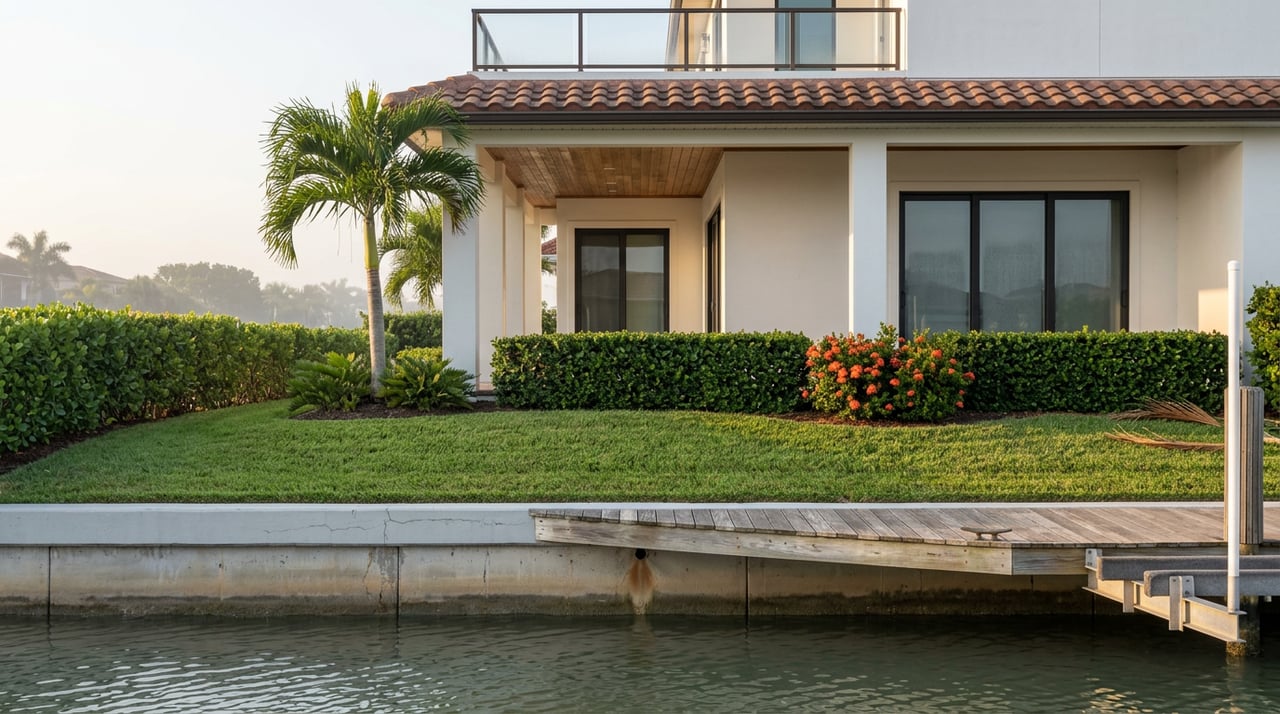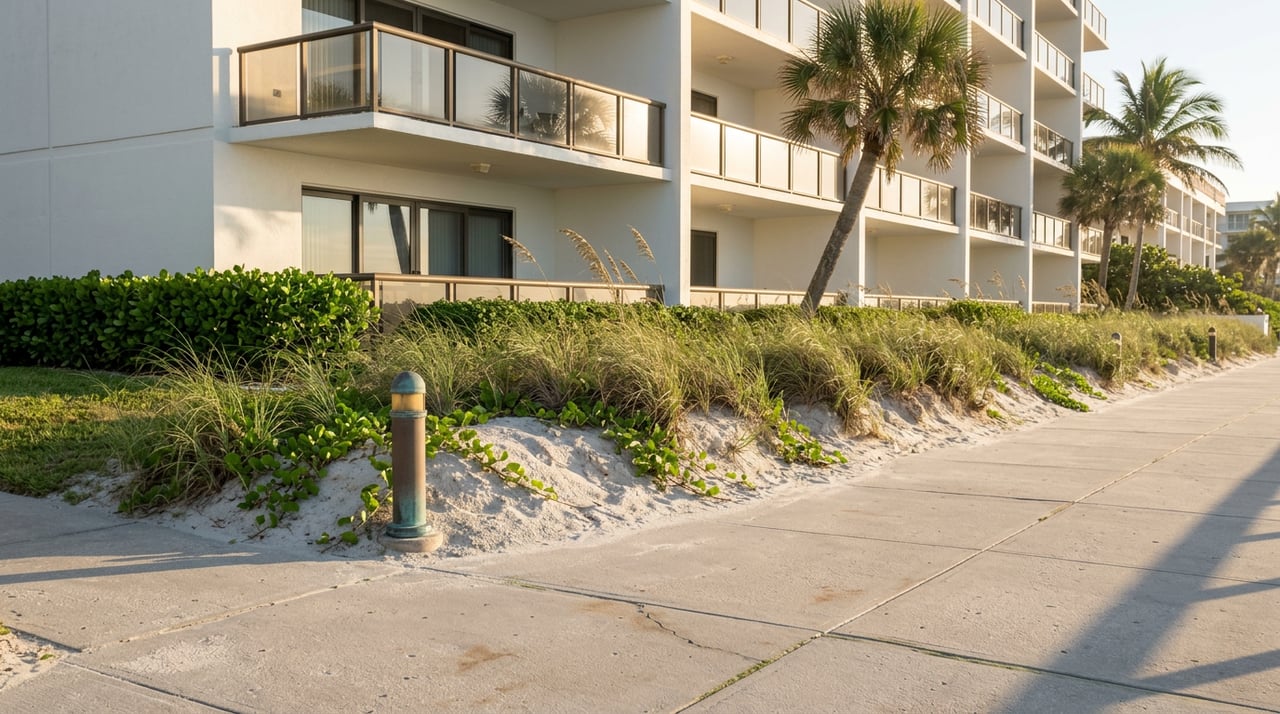
Start at Horizon House and head north along Gulf Shore Boulevard and you will notice something if you are paying attention: the walk changes under your feet. One stretch has crisp new pavers, turtle-friendly light fixtures at even intervals, and dune grass thick enough to hide a beach chair. A few hundred feet later, the lighting thins out, the landscaping looks a season behind, and the concrete has the slightly uneven look of a patch job waiting for its final coat.
Most people chalk this up to maintenance budgets or bad luck. It is neither. The Park Shore beach-walk that residents treat as a single, continuous amenity is not one project. It is five separately governed stretches, each rebuilt on its own schedule, by its own board, with its own contractor, since Hurricane Ian tore through in 2022. Once you know that, the uneven texture of the walk stops looking like neglect and starts looking like exactly what it is: five different recovery timelines, stitched together by a shared love of the same 1.2 miles of sand.
The walk that isn't one walk
The Gulf Shore Association of Condominiums, the nonprofit that represents the community along Gulf Shore Boulevard North from Doctors Pass through Naples Cay, has been blunt about this in its own newsletters: GSAC coordinates and advocates for the beach-walk, but it does not own it. Ownership sits with five independent "beach commons," each tied to the condominium buildings along its stretch. The promenade runs from Horizon House on the south end to LeParc on the north, built in the early 1970s by the Lutgert Company as part of the original Park Shore master development. For decades that federated structure was invisible, because the walk simply worked. Then a 14-foot storm surge from Hurricane Ian arrived in September 2022 and tore out concrete, lighting, and landscaping in wildly different amounts depending on where you stood.
Where Ian hit hardest
The north end took the worst of it. Commons W, V, and T&U, the stretch nearest LeParc, lost their storm dune entirely. Rebuilding it required trucking in nearly a million dollars of sand from a Florida Department of Environmental Protection-approved mine in Immokalee, restoring the roughly 13-foot dune to its original 1970s profile. That work was substantially complete by the fall of 2023, with the concrete walkway poured once the dune had been compacted and hardened.
That timeline matters for one reason: it means the best-looking section of today's promenade is also the section that had to be rebuilt from the ground up, dune and all. It was not spared. It was simply first in line, and its board moved fast.
The center of the walk belongs to everyone, and no one
Roughly at the midpoint sits the Raymond L. Lutgert Beach Park, a 200-foot, 2.7-acre private beach park donated to the Park Shore Association by the Lutgert family in 1978. This is the piece most residents picture when they think of "the beach," but it is worth being precise about what it is. The park itself is a members-only amenity managed by the Association. The concrete promenade that runs past it is a separate structure, owned by the adjoining commons, open for walking but not part of the gated park. It is easy to blur the two into one mental image of "the Park Shore beach." They are governed differently, funded differently, and repaired on different clocks.
The Association marked its own kind of continuity this year. At its Annual Meeting on February 12, 2026, held at Moorings Presbyterian Church, the Association honored longtime member Jo Ann Smallwood with a lifetime membership for what it described as over four decades of advocacy for Naples and Collier County's natural beauty. It is a small item in a newsletter, but it lines up with the larger story: the people paying closest attention to this stretch of coastline have been doing it for a generation, not a news cycle.
The stretch that's still catching up
Head south past Lutgert Park and the pace changes again. Commons S begins at the south end of Lutgert Park near La Mer, and Commons R covers the roughly 400-foot section fronting Surfsedge. These two commons had less structural damage to the walkway itself than the northern stretch, but their dune vegetation, bollard lighting, and interior landscaping were destroyed just the same, and their permitting and construction queue simply started later. GSAC's most recent public update, published in April 2026, put it plainly: much of the area has been restored, but some work remains in the southern section, with resilience planning still underway there.
If you walk the promenade end to end today and the southern quarter feels less finished than the rest, that is not a maintenance failure. It is the honest state of a multi-year, multi-board recovery that is still finishing its last chapter.
Why the lights took longer than the concrete
Nothing captures the slow-motion nature of this rebuild better than the lighting. Every fixture along the walk had to be replaced with a design certified as turtle-friendly, since the promenade sits within the sea turtle nesting zone that the City of Naples and Florida DEP regulate closely. The permitting process alone took months longer than expected, in part because city staff were buried in more urgent post-Ian permits. Once a design was finally approved, the manufacturer hit production shortages driven by demand from other storm-recovery projects up and down the coast. Electrical prep work was underway well before the fixtures themselves arrived.
That patience appears to be paying off. GSAC's sea turtle nesting season update from June 2026 reported that on one City beach, lighting compliance cases had dropped from 25 down to just three, with nest counts outpacing false crawls this season. The bollards that took years to install are doing exactly what they were designed to do.
What's next: paying for resilience
The concrete-and-lighting phase of the recovery is winding down, but the commons are already looking at the next threat. Beach commons boards have been studying an elevated berm project designed to raise the promenade and its underlying dune for better storm resilience. The Association's own planning materials, published in early 2025, described the project as unlikely to be ready before 2026, which is exactly the window the commons are now in. To help fund it, the Park Shore Association raised its one-time initiation fee for new members to $1,000 for 2026, while holding annual dues steady at $300. That decision, made in 2025, was framed around building reserves ahead of the anticipated resiliency project for Commons T/U, R, and S, the same three commons still finishing their post-Ian work now.
In other words, the money raised through that fee increase is earmarked for exactly the kind of storm hardening that would have shortened this whole recovery had it existed before 2022.
The corridor around the walk is changing too
A few signs of investment are showing up just off the sand. GSAC has reported that three concrete plinths recently placed near 4400 Gulf Shore Boulevard North will support a new sculpture by nationally recognized artist Herb Babcock, with a dedication planned for fall 2026. And along the boulevard itself, streetscape work tied to the nearby Naples Beach Club redevelopment has brought new sidewalks with pavers, safer crosswalks with pedestrian warning lights, and bike lanes on both sides of the road, changes that reshape the walk to the beach even before you reach the sand.
None of this erases the uneven texture of the promenade itself. It does suggest a neighborhood still investing in the corridor as a whole, not just patching what broke.
What this means if you walk here
If you live along this stretch, the practical takeaway is simple: your experience of "the beach walk" depends on which commons you are standing in front of. The Association's newsletters and GSAC's own site break updates out by commons and by date, not as one blanket status for the whole promenade. Checking the specific update for your building, rather than assuming the whole 1.2 miles moves at the same pace, will tell you far more than a general sense that things are "mostly fixed" or "still a mess."
Four years after Ian, most of the walk is genuinely whole again. The last piece, in the south, is finishing on its own timeline, funded in part by a fee increase the Association put in place for storms that have not happened yet. That is not a story about damage. It is a story about five boards, one beach, and the slow, particular work of getting it right one stretch at a time.
If you are curious about a specific building or block along this corridor, or simply want a local perspective on how these projects intersect with property values and long-term planning in Park Shore, Mario Furillo is always glad to talk it through. Let's Connect.